Written by Clarence “Clancy” Philbrick
Patriot
Whether I like it or not, I’m a resident of Patriot-nation.
That is, I’m both a fan of the New England Patriots and I’m a United States citizen, which the current regime has sadly chosen as our national brand.
This moniker, in many circles, including most of my own, has had an unfavorable go of it over the last decade. It doesn’t help that the NFL team and its major figure heads, owner Robert Kraft and certified GOAT Tom Brady, spent two decades unapologetically winning Super Bowls by any means necessary before donating large sums to Trump’s campaign and publicly donning MAGA hats alongside their Lombardi Trophies and championships rings.
“Patriot” feels like it has had a similar arch as “Karen.” Over the last decade, at no real fault of individual fans of the team, any association with the word brings forth visions of cringy YouTube ads for rugged sweatshirts aimed at the manosphere or heinous scenes from January 6th insurrectionists and their supporters, defenders, and associates.
Last week, when my Patriots made the Super Bowl, I was, on some superficial level, happy. Not only was the team I root for winning in the playoffs, but there was a small chance to re-write a little bit of the Patriot brand.
However, the larger spread of ‘Patriotism’ sweeping the nation as masked men cosplaying GI Joe’s hell-bent on, at worst, upholding some false-sense of security centered around whiteness or, at best, turning a massive metaphorical blind eye in pursuit of financial gain or absolution of crushing student debt, has me generally sad (read: distraught, angry, overwhelmed, melancholic, or frothing depending on the day) on a much deeper level.
It is also understood by this writer that even the ability to reflect on my emotional state around this bullshit is a privilege and luxury of the greatest extent, as opposed, say, to being thrown into an automatic physiological response state of terror and fight-or-flight.
So, when I openly wept in a sports bar during the Super Bowl, it’s fair to say there were a lot of emotions at play.
I did not weep at Drake Maye’s fourth quarter interception, the ensuing Seahawk’s scoop-n-score, or eventual rout of my Patriots.
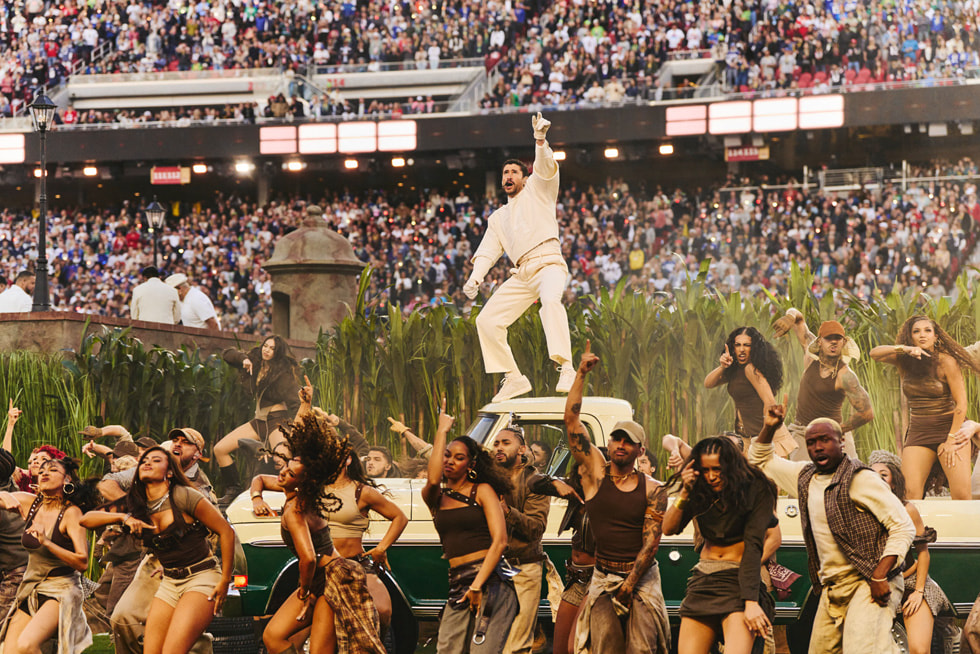
I wept at Bad Bunny’s halftime performance.
Bad Bunny
I wept because it was moving. I wept because of how well Bad Bunny and the team of artists that put together this spectacle synthesized their ideas, conceptual underpinnings, and artistic talent.
I wept because, after shouting out dozens of nations and the general Latin American diaspora and then spiking a football in an emobided act of fuck-you!, how much deep, playful, loving fun Bad Bunny and his crew had as they danced through the show’s final seconds.
I wanted to be there, not slouched on some chair with a plate of tacos and a beer. I wanted to embody that joy and dance. With nowhere for that energy to go, I simply wept.
I read somewhere recently that cute is simply diluted beauty, and beauty diluted terror.
This was beautiful.
I continued to weep because I could feel the wave of feel-good cultural takes, op-eds, and social media posts that would follow. I was both tearfully happy for this unifying moment and deeply sad.
I understood the symbolism. I have been fortunate to travel to Puerto Rico a handful of times. I have been lucky to know, work with, and engage with several Puerto Rican artists that make powerful work on the island’s history of colonization, strong communities, and sharp rebellious culture. Links to their work are at the bottom of this article. My boss is Puerto Rican. I fuck with coquito. This is all to say, I love this special island, its people, and was excited for Bad Bunny to usher in their collective moment in the sun. It did not disappoint.
It was cute, it was beautiful, it was terrifying.
I sat with a profound cognitive dissonance: weeping tears of joy and profoundly sad because I immediately registered this moment for what it also is on a larger scale: sportswashing.
Sportswashing
Sportswashing is the use of sports or a sporting event to present a sanitized, friendlier version of a political regime or operation. Sportswashing can help sanitize a wide swath of nefarious stains through a broad range of scrubbing techniques. Typically, it is scrutinized in international sporting bodies, ie: The Olympics, FIFA, Formula 1 Racing, etc; but just as relevant domestically.
The myopia of most Americans, regardless of political leanings or affiliations, never ceases to amaze me. Filtered through a lens of American Exceptionalism, rugged individuality, and diabolical marketing, we have developed and honed our own special vision, uniquely blind to our violent history and an array of implicit and explicit biases.
Over the last three years, I’ve seen many sports and culture articles articulate that sportswashing itself isn’t new, yet there is an almost universal and cult-like avoidance by American writers, journalists, and sports fans to acknowledge the United States as being complicit in any sportswashing what-so-ever in its 250 year history.
This is, of course, in spite of the fact of nearly 400 years of enslaving peoples from foreign lands, the eradication and erasure of multiple cultures and indigenous peoples through strategic political, social, and military operations, near constant intervention in foreign wars for political and socioeconomic gain, the use of internment camps, on-going human rights violations, AND the founding of three of the five most profitable sports leagues in the world. Fellow Americans—sports fans-–it is time for a reckoning.
Featuring nearly 250 individual entries of incidents, events, teams, and examples, the Wikipedia page dedicated to sportswashing fails to mention the United States of America once. The listings are arranged by sports. They range from Formula 1 to Rugby Union; Soccer to Cricket; Cycling to Horse Racing. Two major sports conspicuously missing: American Football and Baseball. The third pillar of the decidedly American sports triumvirate, Basketball, has only six entries (for comparison, cycling has 14), which implicate The Philippines, China, Turkey, and Rwanda, respectively, but nothing on the NBA, the NCAA, or the Dream Team.
Indeed, it is the American Dream too good to be true. The closest the United States gets to an actual mention are some NFL games held in China (China’s fault, duh), some nefarious foreign-born NBA owners, a WWE event hosted in Saudi Arabia, and an entry on New York City FC (a professional soccer team in the MLS) for their Abu Dhabi and Chinese State-run consortium parent ownership entity, a partnership between City Football Group and CITIC group.
American Sportwashing doesn’t come with the overt bombastic tones of, say, Nazi Germany hosting the 1936 Olympics, the defacto paragon sportswashing event, or the puzzling geography of, say, Saudi Arabia hosting the 2021–22 Supercopa de España. Currently, American sportswashing is so insidious, the detergent is in the water. We drink it. We swim in it.
We even may mistake it for joyous rebellion.
Reactions
There was no shortage of appreciative pieces flying across the zeitgeist immediately after Bad Bunny’s performance. The Seahawks hadn’t even put their talon on the neck of these Patriots before the TikTok breakdowns of the deep symbolism and Instagram carousels highlighting intentional props, culturally-coded outfits, and meticulous celebrities filled social media.
Large outlets followed. TIME highlighted the cultural significance of the sugar cane set design referencing “the territory’s centuries-long colonization” and the power poles addressing Puerto Rico’s electrical grid struggles.
The performance ended with the message “The only thing more powerful than hate is love.”
Progressive media praised it as cultural resistance; conservatives derided it as cultural smut.
This much was predictable.
Much like the No Kings marches last year, this felt like a top-down sanctioned pressure-release. Another orchestrated and allowed ‘rebellion.’ Yes, perhaps as MS NOW and many other self-proclaimed cultural connoisseurs agreed with, this performance was “the clearest, most high-profile cultural rebuke of the U.S. government’s creep into fascism that this country has seen so far.”
However, NFL ownership is more than 95% white and NFL owners are among the highest donors in professional sports, with nearly 95% of their total contributions in recent years going to Republican-leaning candidates and PACs. To think that NFL ownership didn’t sign off on this ‘rebuke’ viewed by some 140 million odd viewers across the United States and millions more across the globe is asinine.
Back in 2022, with the expansion of the LIV Golf League, American sports enthusiasts, fans, and media, for the first time—at least in my lifetime—finally began grappling with the idea that the USA is complicit in sportswashing, albeit through a distorted lens of honesty.
America’s contemporary use of sports to launder its excellence, or at least okay-ness, isn’t as explicit as past totalitarian regimes’ bombastic singular events, but is instead worn into the daily fabric of our country. Like most of America’s maleficence, these stains are veiled by fancy uniforms of democracy, the pursuit of happiness through individual achievement, apparent freedom, the mythology of the American Dream, football field-sized billowing flags, and BOGO coupons.
Noting our history of war crimes, civil rights violations, racial injustices, government corruption, police brutality, and contentious bills around environmental, sexual, gender, and reproductive rights, nearly every major American sporting event for the last 150 years could qualify as a type of both domestic and—with the global appeal of many American sports competitions— international sportwashing.
The ills of our technocapitalist overlord regimes are rinsed daily in a fresh cycle of highlights, scores, top-10 lists, and debates over GOAT status. Personally, I baptize myself in these waters daily: at least one wash in the morning, a quick lather or two throughout the work day, and, depending on the season and playoff status of my teams, I may rinse-and-repeat before bed.
Apparently the suggested use just found it was most effective when spread into the interdisciplinary zone of the half-time show.
Sadly, I know that part of the bath is the nuanced cognitive dissonance of crying happy tears while your neighbor from the same country Bad Bunny just honored may be dragged from their home as you fret whether or not the (true?) Patriots covered the spread.
I am glad Benito Antonio Martínez Ocasio’s performance was deeply political without naming Trump. I love that it chose to rebuke fascism with joy. And, as a straight white man that may never understand the true experience, I can only name that I respect, support, and remain in solidarity with an act of rebellion rooted in a simple refusal to be erased.
Indeed: DeBERERiAMOS TiRAR MáS FOToS.
Meet the Writer
Clarence “Clancy” Philbrick is a Philadelphia-based multidisciplinary artist, educator, and social justice advocate whose work bridges visual arts, social practice, and relational research. His work investigates the transformative power of community, cultural dimensions of sports and play, and disassembling harmful patriarchal norms. Through deeply personal and social projects, Philbrick explores the violence and humor intertwined in dominant versions of masculinity.


Leave a Reply