This is an excerpt of the full analysis published by Nick Jain on Looking Closer. Read the full piece at https://nickjain.com/blog/311-corners-called-311-twenty-times
Half a percent of the addresses in Philadelphia’s 311 records account for six percent of all the calls. Most of them are one property, one problem, filed again and again. The city’s most common reason for closing them is that it referred them somewhere else.
So I pulled every 311 request the city publishes — 553,308 of them, January 2024 through June 2026 — and grouped them by address.
Whose Calling Philly 311 Repeatedly?
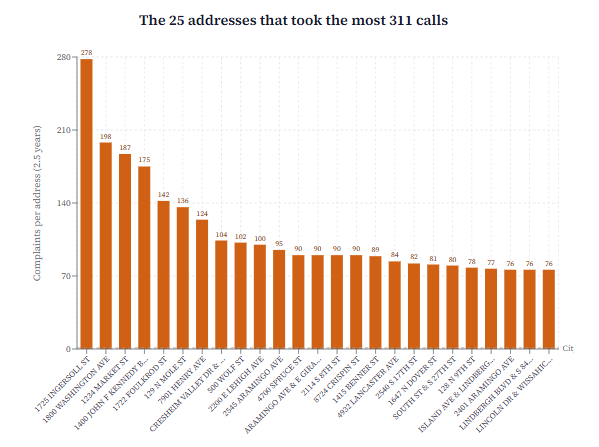
1,058 of those addresses were called twenty or more times. The top of the list looks like this. 1800 Washington Avenue, in Graduate Hospital: 166 illegal-dumping reports over two years and two months. 7901 Henry Avenue in Roxborough: 112 maintenance complaints — one every nine days, counting weekends — and 66 of those are still open. 2114 South 8th Street in Whitman: 87 illegal-dumping reports over 709 days. Every single one closed.
The calls don’t spread thin. They concentrate in a few blocks. That 1,058 is half a percent of the 227,981 addresses in the records and it takes six percent of the calls, twelve times what its share would predict. The addresses that got called once are more than half of the city in the data, and together they take a fifth of the calls, less than half their share. A few places down the list, the counts get much smaller. These are the same handful of blocks, not a gradient across the city.

What that means for someone who lives near any of them is that calling is the only thing that changes anything, and calling doesn’t change anything.
7901 Henry Avenue is not a single-family house. It’s Henry on the Park, a Morgan Properties complex with a 1.5-out-of-5 average on Yelp across hundreds of reviews. The 311 tickets are not one neighbor with one leaky faucet. They are a record of what happens when a big rental building is falling apart and the city’s 311 line is the only lever the people living inside it have.
1415 Benner Street in Mayfair logged 79 maintenance complaints in 422 days, every one closed. Same ticket as the Henry Avenue ones, two neighborhoods with very different reputations. Across the city, a lot of what drives this is just older housing stock — the rowhouse blocks through West and Northwest Philadelphia — and it doesn’t care what the zip code does for a living.
And some of the biggest counts aren’t buildings at all. Cresheim Valley Drive and Germantown Avenue in Chestnut Hill has 76 street-defect reports, 28 of them still open. Aramingo Avenue and East Girard in Fishtown has 70 homeless-encampment reports. Fairmount Avenue and North 25th has 56 traffic-signal emergencies. When a caller gives 311 a corner, the system files it at the intersection, so every call from the surrounding blocks ends up on the same ticket. Those 76 tickets at Cresheim Valley are real work orders. They’re just 76 tickets at a corner, not 76 tickets at a house.
One thing the data doesn’t do is tell you who’s calling. A 311 ticket is a request at an address, not a person, so I can’t tell you that the same tenant filed the 112th Henry Avenue complaint or that it’s 112 different tenants. Nobody should read this as a profile of residents. It describes buildings and blocks, which is the only thing the records actually describe.
I assumed the chronic addresses would pile up in poor neighborhoods. They don’t. Of the 6,868 address-and-problem combinations that got called twenty times or more, 2,856 are in middle-income zip codes and 2,748 are in lower-income ones (a gap of 108, which is nothing). Higher-income zips have 872, about a third as many. Chronic 311 is a citywide pattern, not a poverty one. There just isn’t one neighborhood to fix.
The reason the cycle continues is in how the tickets get closed. The city writes a closure reason for fewer than 15 percent of closed tickets, so what follows is a sample of how the system explains itself when it bothers to. Of the 285 gallery tickets that carry any written explanation at all, the most common reason is “Referred to another organization,” at 81 of them, 28.4 percent. Second is “Issue Resolved,” on 79. Third is “Information Provided,” on 70, which is the police department’s default and mostly means a dispatcher explained the city’s policy. It doesn’t mean the car was towed. Someone called, a dispatcher explained, the vehicle stayed, and the next person filed the same report. The dominant pattern in chronic cases is no explanation.
A dispatcher who picked up the 112th call at 7901 Henry Avenue had no way to see the 111 before it, because each one is a new case with a new number.

Leave a Reply