This is an excerpt of the full analysis published on Nick Jain’s blog, Looking Closer. Read the full piece at nickjain.com/blog/midnight-vendor-ban
If you are a licensed street vendor in Philadelphia, you cannot operate between midnight and 7 a.m. The Code says so directly, in § 9-203(7)(l): no vendor shall “engage in the business of vending between twelve midnight and seven a.m.” The 17-hour operating window is the headline number.
A vendor at 6:55 a.m. is in violation. At 7:05 a.m., the same vendor is fine.
Philadelphia is the only one of four peer cities with a citywide clock-hour street-vendor ban. Chicago, San Francisco, and Boston do not impose one — San Francisco and Boston set hours per-permit, and Chicago’s rules are narrower than ours. New York’s restrictions under § 17-315 are street-by-street, not a universal cutoff, and aren’t directly comparable. We kept the 1950s line. The other three cities decided no.
The arguments for the cutoff are the ones that have been made for thirty years — sanitation, noise, competition with brick-and-mortar businesses that pay rent. Those arguments get us to “overnight is problematic.” They don’t get us to 7 a.m. A vendor selling coffee at 6:30 a.m. to office workers is not creating a noise problem in a residential block. The same arguments could justify a noon cutoff, a 6 p.m. cutoff, or a total ban on street vending. 7 a.m. is where the argument stops being a principle and starts being a number.
In practice, the rule is enforced against unlicensed operators, not licensed vendors — the people selling fruit or water on a Center City sidewalk (or Baklava near the Museum) without a permit. The license protects; the cutoff catches everyone else. Billy Penn documented this in 2016, when the rule was enacted.
We haven’t answered the question of whether overnight vending should be banned at all. We just kept the answer.

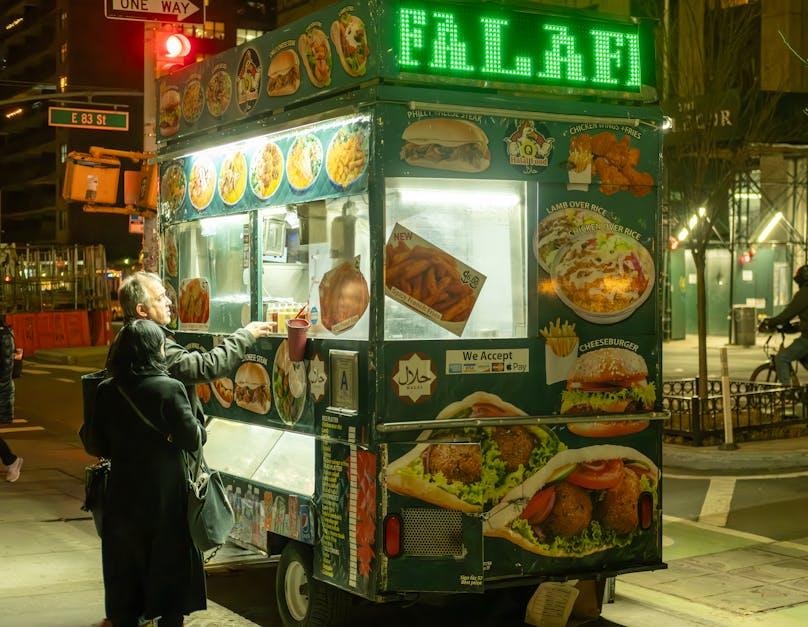
The kind of late-night street vending Philadelphia Code § 9-203(7)(l) prohibits between midnight and 7 a.m.

Leave a Reply