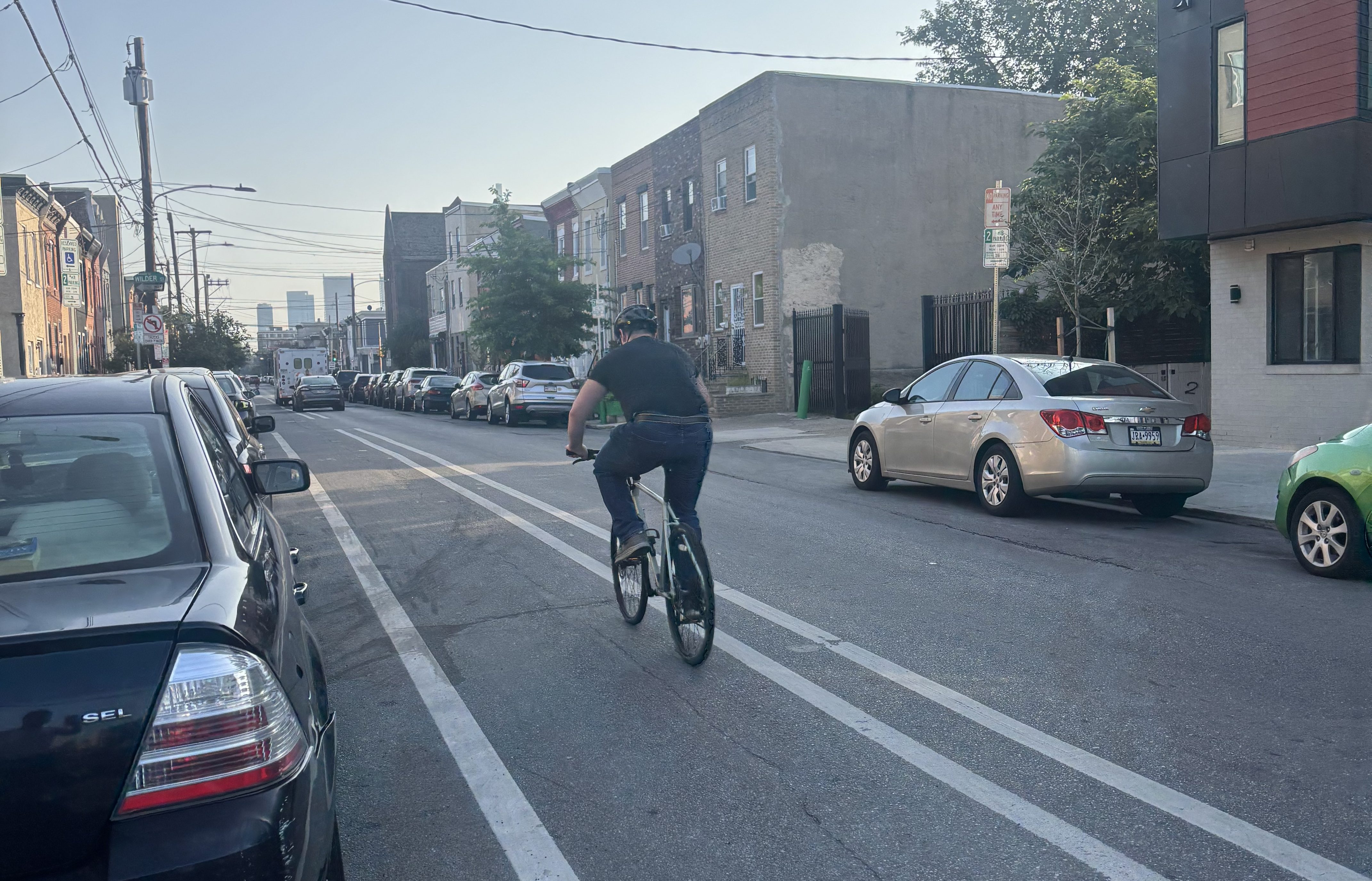
Cyclists are frustrated with drivers. Drivers are frustrated with cyclists. Pedestrians are afraid of everything, and wondering why everyone seems to be on the sidewalk. Welcome to Philly! This article was written to give our readers a better sense of what rights cyclists have when they are on the road.
You may recall the name Stuart Leon from their widely recognized horror font t-shirts, their rogue mission of slapping “NO PARKING” stickers parked in bike lanes while wearing wrestling masks, or simply because of the fact that they win a majority of cases for cyclists. Thousands of Philadelphians rely on bicycles daily to get them wherever they may need to go. Not only that, Philadelphia is the most walkable city in the US, yet it is flooded with motor vehicles. Stuart Leon and his son Zach have dedicated their lives to helping cyclists get justice when they become victims of a crash. We had the pleasure of speaking with them in hopes of bringing clarity to the ongoing debate about car vs. bike vs. pedestrian etiquette and legality.

In 1986, the PA Supreme Court ruled that pedal cyclists have the same legal protections as pedestrians because of the fact their bodies are at the same level of risk. This law gave cyclists a multitude of protections that drivers do not have. Cyclists may use bike lanes and pedestrians may not, however it is not a legal requirement for cyclists to ride within designated bike lanes; to their discretion, they may use the entire lane of a road. Cyclists are required by law to abide by all other traffic laws as motorists, such as adhering to speed limits and coming to complete stops at stop signs and red lights. That being said, it is situational when it comes to safely stopping on a bike. Many people believe that it is unsafe to come to a complete stop at an intersection on a bicycle, and they will quickly breeze through. In this type of situation, the cyclist must use their best judgment and make a choice on whether it is safest for themselves and others to come to a complete stop or to practice what motor vehicles do, which is known as a “rolling stop”.
As far as turning and signaling, cyclists are supposed to signal their turns by extending their arms right or left. Stuart claimed that when many cyclists get hit by cars while turning (or vice versa, cyclists crash into the back of a car while the car is turning), the driver will claim that the cyclist was in their “blind spot.” Zach informed us that anywhere can be a blind spot if the driver is not paying attention. This is also a faulty excuse because legally if a driver is about to make a turn, they must ensure that it is safe to do so. In PA, motor vehicles must allow 4 feet between themselves and a cyclist at all times, no matter what.
When drivers open their parked car doors on cyclists, it is called “dooring.” Stuart Leon’s firm has worked for more door victims than any firm in the world. In his 35+ years of experience cross-examining door openers in court, Stuart said that he will always ask the door opener where the cyclist was the first time the door opener spotted them, and nearly every time the door opener responds with “on the ground.” That statement alone makes any claim of a speeding cyclist inconsistent. “If they had been able to judge how fast the cyclist was going, that means they saw them and shouldn’t have opened the door” says Zach.

Another type of motor vehicle that floods the streets of Philadelphia are motorized bikes and e-scooters. For clarity, pedal bikes with a motor attached are considered e-bikes (think the charged Indigo bikes) and must abide by bicycle laws. Whiz bikes, e-scooters and other supercharged bikes with larger wheels that are not mopeds or motorcycles are basically rogue modes of transportation that cannot be insured and there are no laws protecting the riders of them. Additionally, there are no laws about what e-scooter riders must do on the streets to protect themselves and others, which is why they can be seen on sidewalks going upwards of 30 MPH. The police do not stop them, the Philadelphia Parking Authority doesn’t ticket them, because they legally can’t. If any e-scooter or motorized bike rider wishes to insure their transport device, it would need to be included in any homeowners or renters insurance policy they may have, which Zach says is incredibly rare.
Concerning helmets and other protective gear, Zach told the Philly Plain Dealer “Obviously you should be wearing a helmet, but there is no law that requires cyclists to wear helmets above the age of 14.” Just because a cyclist is not wearing a helmet, they are not automatically at fault if they are a victim of a head injury when hit by a motor vehicle. If a cyclist goes to court over a crash, their lawyers can instruct the jury to not use the fact that the cyclist was not wearing a helmet to impact their decision on whether or not to award the cyclist the money they are asking for.
Philadelphia is a beautiful place, and it is beautiful because of the diverse population of people it homes. Let’s look out for one another, keep an eye out for bikes, and practice caution and consideration for our neighbors to make sure it stays beautiful here.



Leave a Reply