“No Kings” protests are built on a simple premise: that no one in American democracy should wield unchecked power. The “No Kings” protests are a nationwide protest movement opposing authoritarian behavior—especially tied to Donald Trump’s second presidency.
They’re not a single march—they’re a series of coordinated, mass mobilizations organized by Indivisible, MoveOn, and other grassroots networks.
But as recent arrests make clear, power doesn’t need a crown to assert itself.
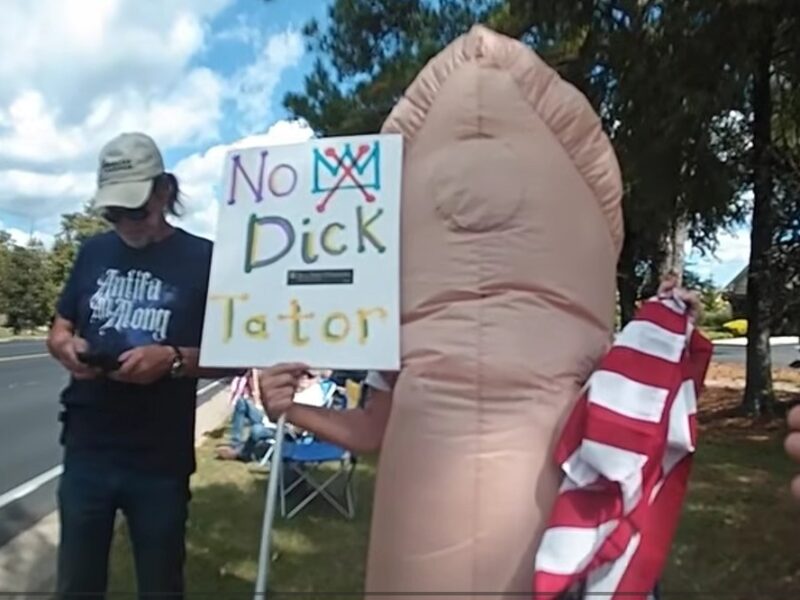
At a “No Kings” protest in 2025, a woman named Renea Gamble showed up in an inflatable penis costume holding a sign that read “No Dicktator.” It was crude, unmistakably political, and well within the long American tradition of protest as satire. Renea Gamble was arrested after police deemed her inflatable costume “obscene” and charged her with disorderly conduct and resisting arrest. Even without a conviction, the consequences of an arrest are real: time in custody, legal fees, missed work, public exposure, and months of uncertainty. By the time a case is dismissed, the police state has already imposed its cost.
Protest takes many forms—marches, sit-ins, occupations, acts of civil disobedience, even satire and performance. People turn to it when formal systems fail to respond, using visibility and disruption to force attention and, at times, negotiation. Historically, these tactics have driven some of the most significant changes in American life, from civil rights protections to labor laws to shifts in policing and public policy. But because protest works, it is also closely managed—shaped by rules, enforcement, and legal processes that determine not just what can be said, but who can remain, and for how long.
In Philadelphia, this tension has a long history.
Philadelphia has always been a protest city. From colonial-era uprisings to 19th-century race riots, from civil rights sit-ins to the MOVE bombing, conflict over public space and political power has shaped the city’s history. More recently, movements like Occupy and the 2020 racial justice protests brought thousands into the streets, often met with aggressive policing. What’s changed is not the presence of protest, but the method of control. Suppression is often managed through arrests, regulations, and legal processes that shape who can stay in public spaces, and for how long.
In the years immediately following Donald Trump’s first election, Philadelphia saw a surge of mass demonstrations: airport protests against the travel ban, the Women’s March, immigration rallies, anti-policing protests. These were large, visible, and often disruptive. But they were also, in many cases, tolerated. The model was familiar: permits, police presence, occasional arrests, but no systematic escalation.
That changed in 2020.
After the murder of George Floyd, Philadelphia became one of many cities where protest and policing collided at scale. Demonstrators filled highways, and occupied public space, Police responded with tear gas, rubber bullets, mass arrests, and containment tactics that swept up not just protesters, but residents and bystanders.

Later investigations found what many already knew: excessive force had been used. Leadership had failed. The response was uneven—aggressive toward racial justice protesters, restrained toward groups aligned with police. The city ultimately paid millions to settle lawsuits.
On paper, that moment produced reform. Philadelphia banned the use of tear gas and certain crowd-control weapons against protesters. Officials promised a different approach going forward.
But the crackdown did not disappear. It evolved.
In the years since 2020, protest in Philadelphia has been managed less through overt force and more through process.
Arrests still happen—at encampments, at campus protests, at demonstrations tied to national movements like the war in Gaza. Charges are filed. Sometimes they are serious. Often, they do not hold. Cases are dropped. Prosecutors decline to move forward. Judges dismiss them.
But by then, the system has already imposed its cost.
The point is not always to secure a conviction. It is to impose friction: time in custody, legal uncertainty, repeated court dates, the risk—however small—of a criminal record. It is to turn participation in protest into something that must be calculated in advance, weighed against consequences that extend far beyond the moment itself.
This is what links a case like Renea Gamble’s to what is happening in Philadelphia. Not the specifics of the costume, or even the charges, but the underlying logic.
The system does not need to prove that protest is illegal. It only needs to make it administratively burdensome.
Legally, the right to protest is clear.
The right to protest is grounded in the First Amendment to the United States Constitution, which protects speech, assembly, and the ability to petition the government. It was adopted in 1791 as part of the United States Bill of Rights, shaped by colonists’ experience under British rule, where dissent and public gatherings were often suppressed. Over time—especially through the Fourteenth Amendment to the United States Constitution and a series of 20th-century Supreme Court decisions—those protections were extended to limit state and local governments as well. But in practice, those rights are often tested only after the fact: police act in the moment, using broad standards like “disorderly conduct” or “failure to disperse,” and courts sort out legality later—after the system has already imposed its cost.
At the same time, the legal landscape around public space is changing.
The Supreme Court’s 2024 decision in City of Grants Pass v. Johnson didn’t directly address free speech. It addressed homelessness, holding that cities can punish people for sleeping or camping in public—even when no shelter is available. But the ruling expands something just as important: government control over public space itself. Protest rights depend not only on what people are allowed to say, but where and how long they are allowed to remain. By widening the scope of what counts as punishable conduct in public, the decision makes it easier to police presence—giving authorities more tools to disperse, cite, or arrest people before courts ever reach the question of whether their expression was protected.
Most protests in the United States, including in Philadelphia, remain overwhelmingly peaceful. That has been true even during periods of intense political conflict. What has changed is not the baseline behavior of protesters, but the mechanisms through which protest is contained.
You don’t have to outlaw protest to control it.
You just have to make it costly enough that fewer people participate. You have to create a system where the risk is not just what happens in the street, but what follows: the paperwork, the hearings, the uncertainty, the exposure.
That’s what makes cases like Renea Gamble’s so revealing.
A judge acquitted Renea Gamble of all charges on April 15, 2026, months after her arrest at a “No Kings” protest. By then, she had already been arrested, charged, and required to navigate the court process—illustrating how the system can impose consequences long before it determines whether a crime occurred.
But by then, she had already been through the system designed to make sure that speaking out is never as simple as showing up.
However, crackdowns don’t always silence protest. At times, they do the opposite. When enforcement appears excessive or arbitrary, it can draw attention, shift public opinion, and expand participation. Images of arrests or force often travel further than the protest itself, turning local actions into national stories. In some cases, repression has even produced legal challenges and policy reforms that outlast the moment. The harm is real—but so is the possibility that attempts to contain dissent can make it more visible, more legible, and harder to ignore.
Without Renea Gamble’s arrest, her “no DICKtators” penis costume might have gone unnoticed. Instead, the crackdown made it visible. Gamble’s arrest amplified the NO KINGS movement, turning a local act of dissent into a national conversation about speech, power, and our civil right to protest.
Leave a Reply