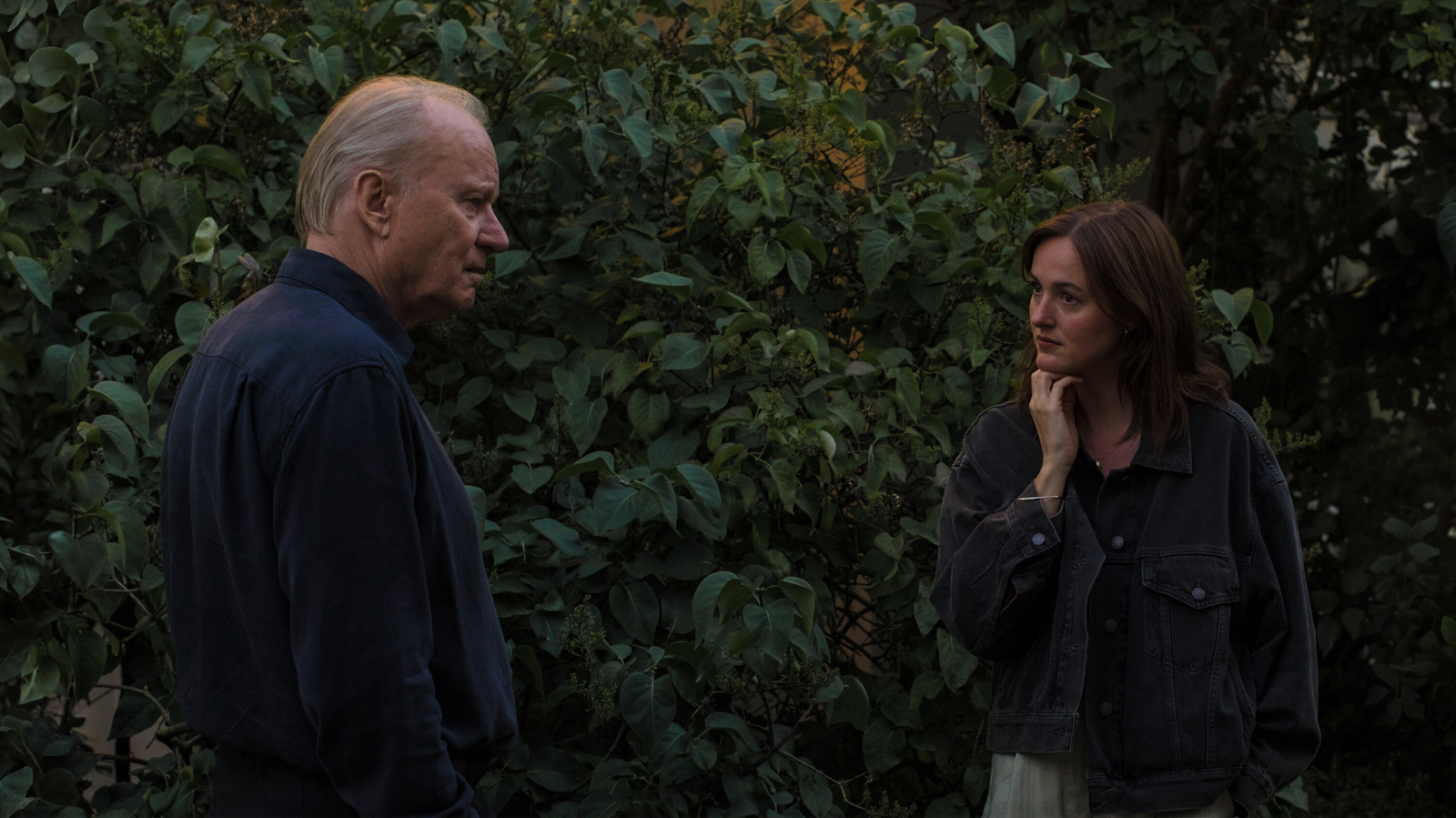
Joachim Trier is a “seasons” guy. Sentimental Value opens on Oslo’s late summer canopy, and if you look closely (that is, if you’re into seasons, too) you’ll notice small bursts of orange presaging the fall. I’ve never been to Oslo, but I recognized that canopy from Trier’s other films, just as I recognized Renata Rensve and Anders Danielsen Lie. The world of Sentimental Value will feel familiar to viewers of Joachim Trier’s three prior Oslo films (Reprise; Oslo, August 31st; The Worst Person in the World) but these resemblances elide the break between this film and his others. The Oslo trilogy followed the young and selfish on existential journeys. Sentimental Value is a psychological drama about family and art-making.

Aging auteur director Gustav Borg (Stellan Skarsgård) wants his estranged daughter, Nora (Renata Rensve), to star in his film, but she refuses, so he hires big name Rachel Kemp (Elle Fanning), who gets him Netflix money and asks very American questions of his repressed Scandinavian family. He enmeshes his other daughter, the dependable Agnes (Inga Ibsdotter Lilleaas), in the project by casting her son. All this cross-pollinating brings up old family issues which can only be resolved, predictably, through the making of his movie.
The films in the Oslo trilogy were vital and zeitgeisty. I feel about them the way I feel about my favorite podcasts: I like them a lot, but they’re embarrassing to like and don’t always age well. Reprise may as well have been subtitled “Karl Ove Knausgaard’s twenties: the movie.” It’s about being young and ambitious and friends with a bunch of wannabe punks who drop Deceptacon by Le Tigre to rally a party. But then, because it’s 2006, the main female lead out-manic-pixies Zooey Deschanel. In The Worst Person in the World, an indecisive Julie freewheels into her thirties. What’s a woman to do when she has more freedom than all her maternal line, but no idea what to do with it? Eat a bunch of mushrooms and paint her face with a tampon. But the film takes cheap shots at feminist politics and leans on Freudian theory (daddy issues) to tidily explain Julie’s insecurities. True to 2022, it’s aware enough of how it might be criticized: Julie decides to cheat on her boyfriend while he’s rambling on about Freud. Oslo, August 31st—actually, this film from 2012 holds up, but then, its main character concludes it’s better to kill himself than rebuild by writing think-pieces on “Sex in the City through the eyes of Schopenhauer.”
I’ll take the au-currant faults of Trier’s old films over his latest well-crafted drama. The philosophical questions of what’s the point of all this and how to live now and, paraphrasing Camus, why don’t we all just kill ourselves, may be for the immature and childless, but they animated a trilogy that reveled in the feeling of freedom.
In Sentimental Value, the question of suicide is not philosophical. Suicide and depression run in the Borg line, and this unhappy family is not so unlike any other. Gustav is a good father to his actors and inconsistent toward his own children. He defends his selfishness by arguing that Joyce couldn’t have written Ulysses while going to kid’s soccer names and buying car insurance. (Okay, dad.) An “I love you” between sisters is moving, and yes, sentimental: an expression of how deeply we need one another. Trier is still interested in how we live now—a tell of Nora’s depression is an open laptop on the kitchen table, as she spends her days streaming rather than working —but his inner realist won out over the existentialist. The old films were not as mature. Neither were their mosh pits, gatecrashing, or late-night bike rides through Oslo.
At my screening, I sat behind a crew of young adults who ignored the previews and laughed through the opening credits, passing around a fifth of vodka. How they’d ended up at an early screening of a tasteful Norwegian-language film is beyond me, and it doesn’t matter. Midway through the film, one of them began yakking. None jumped up to help, though two of the gang cracked up and left the theater for good. The puker went away for a bit, came back, and sat in the same spot (presumably stepping in it?), only to be whisper-scolded by a friend. The whole gang was straight out of Reprise, whose protagonists would have trolled the crowd at Sentimental Value and laughed about it afterwards. That’s living.



Leave a Reply