
A Big Bold Beautiful Journey
It was not a promising title. Near the beginning of the film, Colin Farrell’s character performs a call-and-response with his rental car’s GPS that ends in his yelling “I want a big bold beautiful journey,” and for a moment you feel the actor and script might be in on a joke. As it turns out they are not.
The movie, directed by Kogonada, is billed as a romantic fantasy in which Margot Robbie and Colin Farrell play Sarah and David, two no-longer-young singletons who know just as well as we do they’re too gorgeous and winning to be single. They’re broken, of course. After they meet at a wedding, a sassy GPS yenta wrangles them into a road trip, directing them to uninhabited landscapes. At each destination they find a standalone doorway which they must walk through in order to revisit key traumas and scenes from their past.

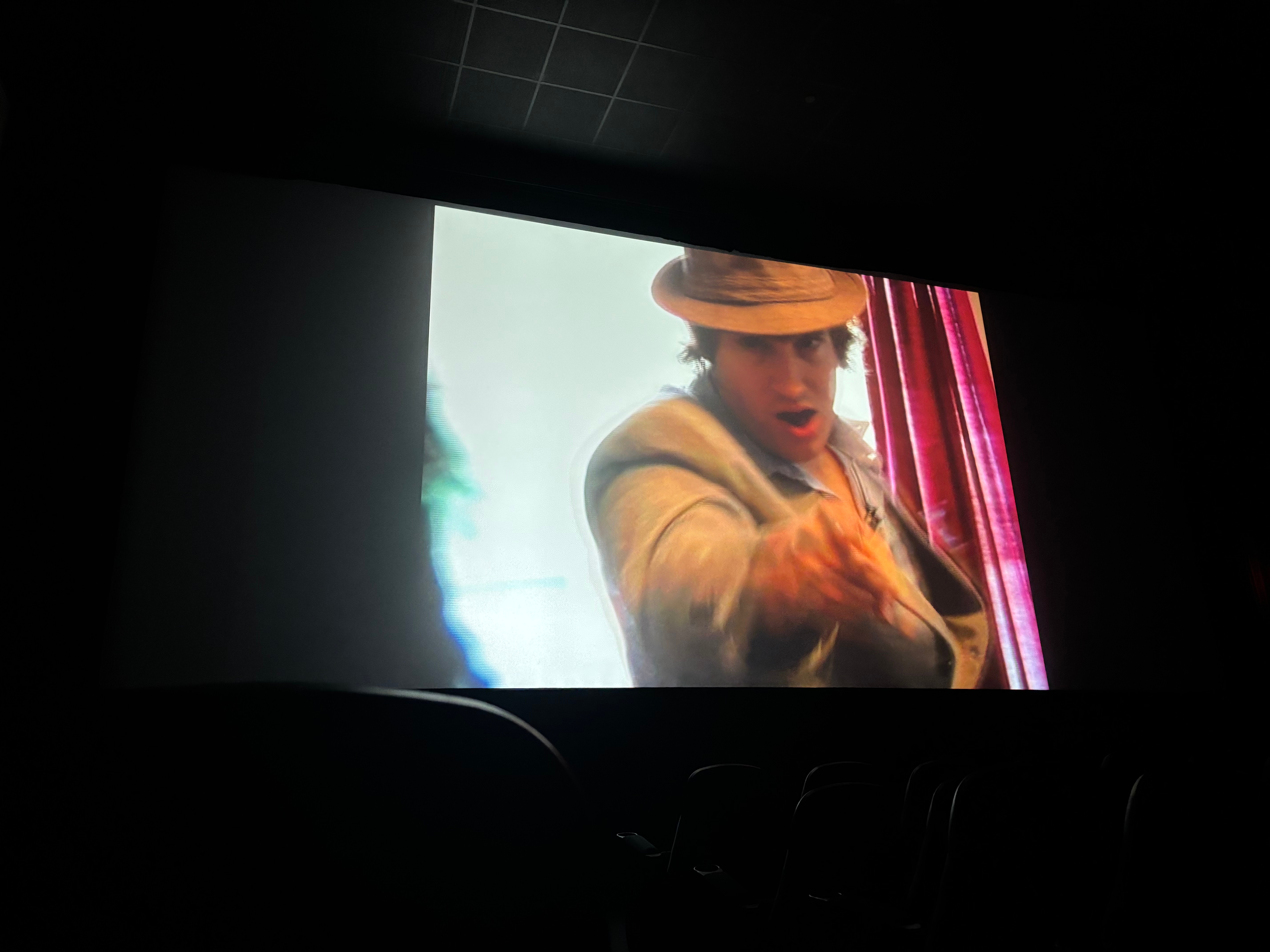
This totally sexless film does have gender parity, as each side of the romantic moiety takes their shirt off exactly once, but neither Sarah nor David seem piqued by what they see. In the most delightful scene, David pushes open the heavy blue doors of his high school and performs the lead in the musical. A middle-aged Farrell playing a fifteen-year-old high school theater kid going for broke in How to Succeed in Business Without Really Trying is pure cinematic charm. The scene reminded me of a precept I hold, which is that romantic comedies are better than romantic dramas because they know not to treat the solemn stuff of life so solemnly. This movie deals very seriously with the death of a parent, abandonment of a parent, overly-affirming parents, health issues, disappointment, fear, self-loathing, and the gaping void inside all of us, but it doesn’t deal seriously with the giddiness that comes from falling in love.
Kogonada’s first feature, 2017’s Columbus, filmed amidst the architectural grandeur of Columbus, Indiana, was straightforwardly beautiful; his second, 2021’s After Yang, set in a lonely, less-human future, was disconcertingly so. I was ready to grant this movie its beauty too, but the more I thought about it, the more addled I felt by its title. Everything looks nice, but beautiful? In an early scene, rain begins to fall over a wedding procession, and there’s an overhead shot of umbrellas going up. The visual recalled an Instagram photo I’d seen of a street with a whimsical ceiling of multi-colored umbrellas—in Ireland, maybe? Taipei? Manayunk? Their appeal is that they look nice—anywhere. The umbrella shot serves as a good visual metonym for the movie’s main problem, which is that the characters might well be anyone from anywhere. That this universality and “Everytown, USA” feel is intentional—the characters are introduced to one another as David from the North Side and Sarah from Downtown, City Unknown—makes me wonder whether Kogonada was more interested in examining romantic commitment as a subject than in directing a romance. The people and places in After Yang were universalized too, but the film was asking philosophical questions about what it meant to be human. Its lack of specifics served a purpose.
Maybe A Big Bold Beautiful Journey’s marketing worked against it. Romance audiences have rigid expectations. We go to the movies to watch two individuals fall in love, but this one was a romance between two generalized sets of hangups, and not very compatible ones at that.
Downton Abbey: The Grand Finale
It could’ve been avoided. There was only one other person in the theater on A Big Bold Beautiful Journey’s opening night, and I thought to myself, ugh, should I run into the 7pm Downton? While leaving I passed a trio of retirees dishing on Lady Mary in front of the poster outdoors and knew I’d made the wrong choice.
I’ve seen all six seasons of Downton as well as its last two movies, one of which borrowed liberally from the plot of Singing in the Rain. I disclose this to admit that, having spent so much time in the Downton universe, I’m in too deep to judge whether the movie was “good” or not. I doubt that someone who’s never seen the show will find the film legible, but then, who but a fan is going to see Downton Abbey: The Grand Finale?

Directed by Simon Curtis and written by the show’s original creator, Julian Fellowes, the supposedly final installment is about moving on and letting go. It’s 1930 and the American capital funding Downton Abbey’s home improvements vanished in the stock market crash of 1929. Old familiars Lord Grantham, Mr. Carson, and Mrs. Padmore, are retiring and handing over their responsibilities to the next generation of aristocrats, butlers, and cooks, respectively. The daughters of Downton have been married off for so long that there’s nothing left but for Lady Mary to divorce, for which she faces social ostracization. (This storyline also featured in the most recent season of Fellowes’s American show, The Gilded Age, but no matter. You don’t watch Downton for new ideas or fresh politics.) What else is there to say? Paul Giamatti guest stars as the American uncle who can’t get through a Dickens’ novel, Lady Edith foils a scheme at the Ascot Races, a newcomer in a gold-chain necklace batch prepares old-fashioneds, and the children remain in the nursery, unseen and unheard. It’s a genre: you either like this shit or you don’t.
About a third of the way through my screening, a group of teenagers debouched into the theater, laughing, and began filming TikToks, neither noticing nor caring that their phone’s flashlights kept beaming into my eyes. Couldn’t they see that they were interrupting a pivotal scene, one in which the recently retired butler Carson oversees the new butler’s polishing of the candlesticks and struggles to accept his successor’s new way of doing things? I wanted to yell at the teens to shut up, but it was too on the nose. Then I’d have to align myself with the olds in Downton Abbey, always nagging the next generation.

Leave a Reply