Bugonia, directed by Yorgos Lanthimos
I think I could plot my friends and family onto a matrix to predict how much they’d vibe with Yorgos Lanthimos’s Bugonia. The X-axis would measure their level of online-ness (this would track how much the film resonates) and the Y would measure their affinity for either the dirtbag left or comedy podcast-sphere (this would track their filmgoing pleasure*). Go ahead, plot yourself. I land in the middle of both, which might explain my ambivalent reaction toward one of the more bracing movies I’ve sat through this year.

Bugonia is a film about the unraveling of our shared reality. Maybe. A very online warehouse worker, Teddy (Jesse Plemons) becomes convinced that the CEO of biotech company, Michelle (Emma Stone), is an alien from outer space, and, together with his gentler, less certain cousin Don (Aidan Delbis), kidnaps and tries to torture the Truth out of her. The screenplay, written by Will Tracy of Succession and The Menu, refreshes familiar online debates by putting them into the mouths of very good actors, who, being good actors, express a whole lot more fear, pain, and doubt than text on a screen. While watching, I kept asking the same question: what is this? Is the film a critique of global capitalism and Big Pharma’s evil? A revenge plot? An expression of righteous anger mixed with begrudging respect for the girlboss? A portrait of a young man as an online conspiracist? An aesthetic response to internet overload? It could be any or all of the above, but part of me suspects Lanthimos might be laughing at our attempt to make meaning of it at all.
Joan Didion, who shared with this film a strain of nihilism and alertness to memetic language, once said she wanted the last line of her novels to make readers go back and restart from the beginning. Bugonia’s ending, which should not be spoiled, has this effect. All I’ll say is that the final scene, which zooms out from a very American exurban setting—with a strip mall anchored by a Piggly Wiggly, an all-American cast, and all-American dialogue—to cycle through playfully dark shots of the broader world, reminded me that Yorgos Lanthimos is very much not American, but Greek. Fatalistic humor is harder to come by ’round these parts.
*Yes, the casting of Stavros Halkias led me to this measure. His appearance on screen got more than a few snorts out of the audience.
It Was Just an Accident, directed by Jafar Panahi
Thematically and plotwise, It Was Just an Accident shares a lot with Bugonia: van kidnappings, the Truth and doubt, a lust for revenge, humanity, torture, and drama by dialogue. But the people of Panahi’s film feel as offline as Bugonia’s are online, and its setting is the director’s homeland of Iran, with which he has a complicated relationship.
Part of the thrill of watching Iranian cinema as an American is glimpsing a place you can’t see in person. For those of us who aren’t Persian-American, who have no personal ties and are not highly informed, our sense of what Iran looks and feels like right now comes from film. We can’t really know present-day Tehran; we can only know Tehran of the news, or Tehran as played on camera, like Panahi’s Tehran, with its venal security guards and tough-as-nails women and stray dogs barking at night.
The film opens on a family man, his pregnant wife, and pajama-clad daughter, driving in the dark along a bumpy road in the outskirts of Tehran. The girl is hyper; she wants to bounce to loud music with her stuffed dog. Her father says no, folds, then runs into a real dog. Soon after, their car breaks down. Bad luck on film creates sympathy for the family of three. When they stop in a roadside warehouse, a worker, Vahid, IDs the man before he can be spotted. Vahid trembles, hides, disguises his voice. Our sympathies begin to shift. The next day Vahid kidnaps the family man, drives him out to the desert, and begins to bury him alive. Then doubt sets in: does he have the right man?
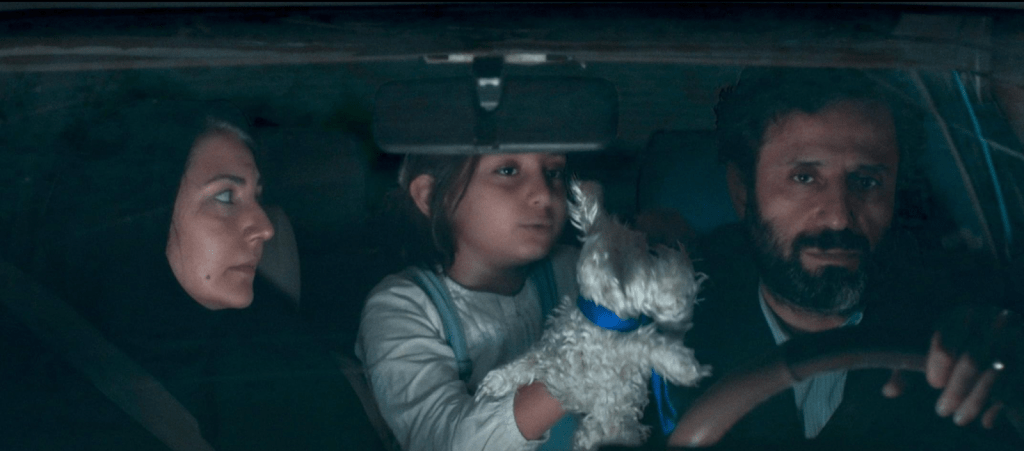
Sandwiched between a great beginning and ending of It Was Just an Accident is a more conventional middle, with funny situational humor, bits about the country’s corruption, and a set of six people whose characters are defined by their responses to Iran’s regime. The story fills out as each character testifies to their torture in prison at the hands of Eghbal, who they are mostly sure, but not 100% certain, is the man in the van.
The ethical questions and psychological portraiture are what gets the film called “important” by critics. They’re also the least interesting part of the movie. They reprise moral questions you’ve heard before, and each character feels like an archetypal response to injustice and torture (Anger, Paranoia, Trauma, Forgiveness, Collusion, etc.). More thrilling was the movie’s stage play-like dialogue, which had a stage play’s effect of thrusting one back on oneself. You begin to note how easily your sympathy is manipulated, just as the characters’ sympathies are manipulated by the same issues at hand: torturer as good father, doubt, an innocent child, revenge as self-pollution, and an irrational desire for martyrdom. That’s not such a bad thing. The uncertain characters have the most humanity. Both Bugonia and It Was Just an Accident find there is little more terrifying than being confronted with another human’s absolute belief.




 Philly Plain Dealer
Leave a comment