
This article is featured in the Philly Plain Dealer Second Print Edition.
On the opening weekend of the new Calder Gardens on the parkway, the autumn solstice still bears an unrelenting sun, carried over from summer. Even a passing glance at the building’s impressively reflective surface requires an eyebrow raising squint to save from the bouncing light. Approaching the entrance feels a bit like deciding whether to walk into a portal.
Alexander “Sandy” Calder (1898-1976), the artist to whom this building is dedicated, is most known for his invention of the ‘mobile,’ spindly kinetic sculptures held together by gravity that gently spin in the slightest wind. The impact of the Calder family line can be seen dotted throughout Philly—his grandfather Alexander Milne Calder sculpted the William Penn statue that sits atop City Hall—which made it a worthy investment for the city to contribute $20 million toward the $100 million project. But unlike many of the building’s arts neighbors, the Calder Gardens overtly rejects the rigid label of ‘museum’, and aims instead to lean toward being an “ever-changing environment that encourages close looking and repeat visits.”
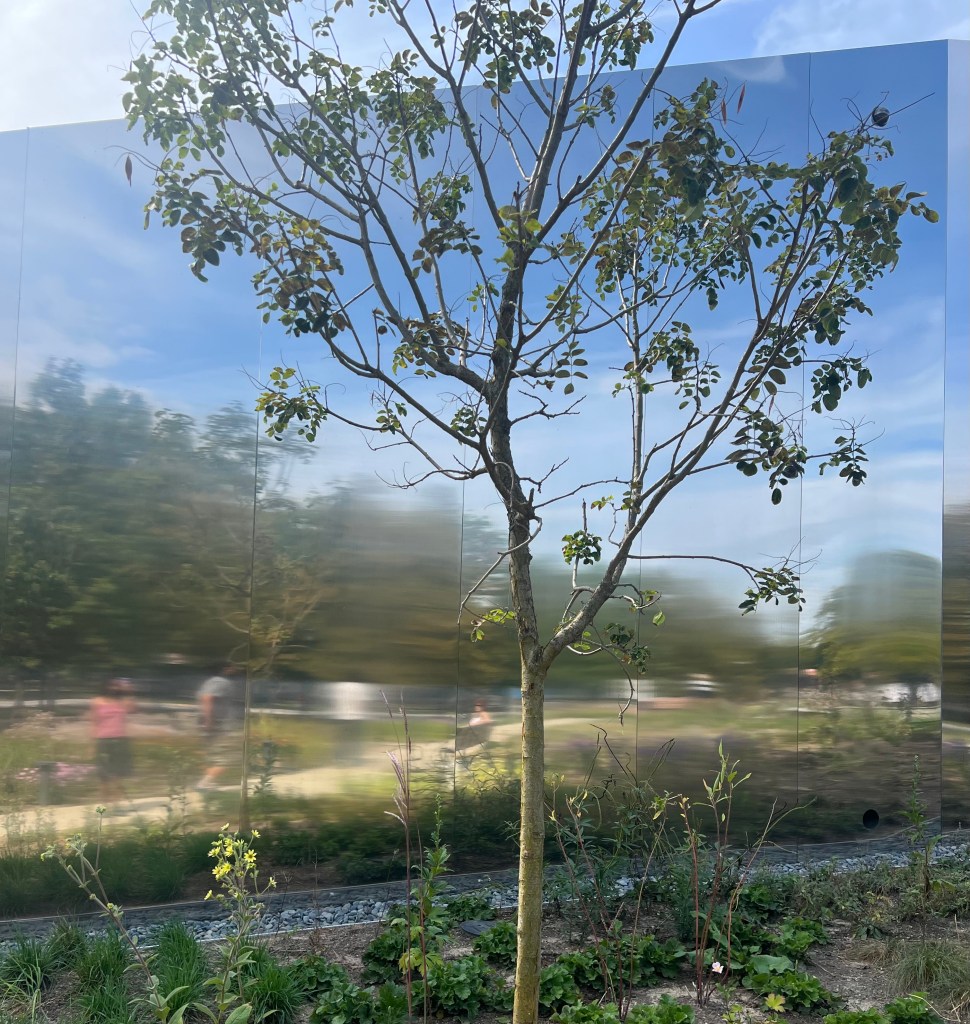
Its prime location on the parkway, across from the Barnes Foundation and steps away from the Rodin, lends itself to just that, as cars whizz by just below the entrance. Among these, a U-Haul truck circles the block searching for parking, to no avail.
The U-Haul Gallery, led by James Sundquist and Jack Chase, has dubbed itself “the only gallery with a transmission.” Quite literally ever-changing, their mobile gallery model operating out of U-Haul trucks is designed to disrupt, challenging the old-guard of lofty brick-and-mortar exhibition spaces. They put themselves on the map this past summer by causing a guerilla-style stir at the Chelsea Art Fair in New York City, and have since popped up at (and gotten kicked out of) the London Frieze Fest, and Le Marais in Paris—bringing the ‘U-Haul’ name to international markets before the actual company has had a chance to.
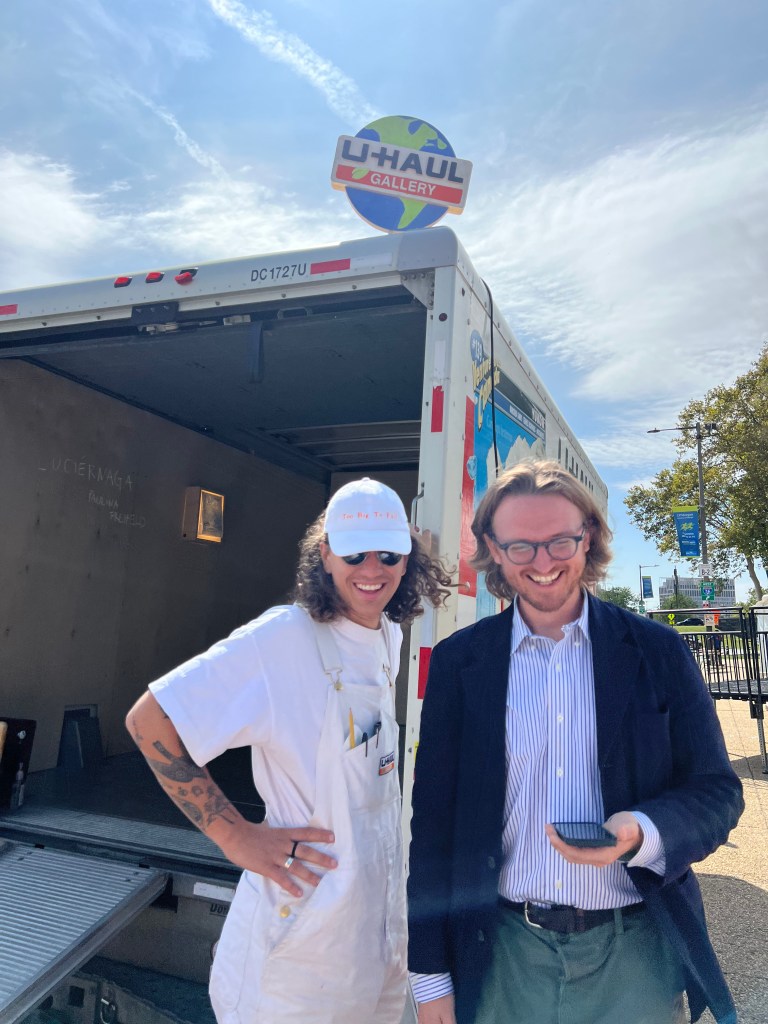
“We have big ambitions,” Sundquist asserts at the foot of the Rocky steps, where they finally found a parking spot, “our primary goal is to get a Rothko in the gallery before the decade is over.”
Assembled in the hull of a truck, their exhibitions change every few weeks. The iteration that made its way to Philly is titled Luciérnaga (translates to ‘firefly’), featuring lightboxes by artist Paulina Freifeld, who is originally from Mexico City. The glowing blue imagery in these works has been primarily sourced from the endangered flora and fauna found on Mexican Pesos, which presents an interesting paradox, as Sundquist explains “systems of the economic engine are partially responsible for ecological collapse.”
Migration and global trade of course come to mind, too, inside a moving van. Site specificity is the name of the game for U-Haul, since every exhibition doubles as a gesture, a ‘movement.’ The shell informs the body. These guys are ruffians, pranksters even, but they’re surprisingly as thoughtful as they are brazen. Their premise is essentially borne out of artistic necessity: “There’s a lack of access to commercial space in most urban centers that makes it nearly impossible to start projects”, explains Chase, “people want to run businesses, but it’s hard to do.”

Alongside the artwork, the gallery’s ‘store’ sits on a table just outside the truck, with t-shirts touting “i ❤ China” and an image of the late Pope Francis, “the greatest art patron ever” according to Sundquist. Chase dons a hat with embroidered text that reads “Too Big To Fail.”
One might assume that U-Haul is often dwarfed by the big institutions it parks in front of, but this relationship is typically symbiotic, as crowds flocking to the gallery tend to generate more foot traffic for the static spaces that surround it. In this case, though attaching to the Calder Gardens was unsuccessful in practice, the gesture offered more to the space than its administration may have even realized.
The Gardens’ mission is to be a site for transience, “a place where an evolving interplay between art, architecture, nature, and programming encourages contemplation and self discovery” meant to change with the seasons. However the building itself, designed by international architecture firm Herzog & de Meuron (notable projects include the Park Avenue Armory in NYC and the Tate Modern in London, among others), though striking, is decidedly fixed. The strength of the space going forward will be measured, in part, by its function as a platform for rotating external voices.
Its first commissioned projects will run from fall 2025 to summer 2026, enacted by Chilean poet and artist Cecilia Vicuña, and Diné composer Raven Chacon. As of now, the website still notes “stay tuned for more information.”
Alternative art spaces are continuing to become a more attractive option than traditional exhibition routes. If they’re lucky, they don’t have to worry about explaining themselves or being taken seriously—they just have to show up and prove it.

 Philly Plain Dealer
Leave a comment