
After some time living in Philadelphia, you get so used to just waiting for the train every 10-15 minutes that it’s easy for one to forget that there still no clock for wait times on the train platform. It feels like we’re stuck in the stone age over here.
For the Broad Street line (BSL) and Market Frankford Line (MFL) trains, (most of them at least) the only way of knowing a train is coming is to download the Septa transit app and hoping it is accurate. Thinking about taking the bus instead of the subway? According to Drexel’s Student ran newspaper The Triangle “despite buses having tracking capability, the SEPTA app is often wrong or unsure about where the buses are or if they are even coming at all.”
You could ask someone at the subway platform or bus stop about the times, but they probably don’t know either. SEPTA is repeatedly in the news for fare hikes, incidents above ground and underground, bus route changes, Septa strikes and budget issues.
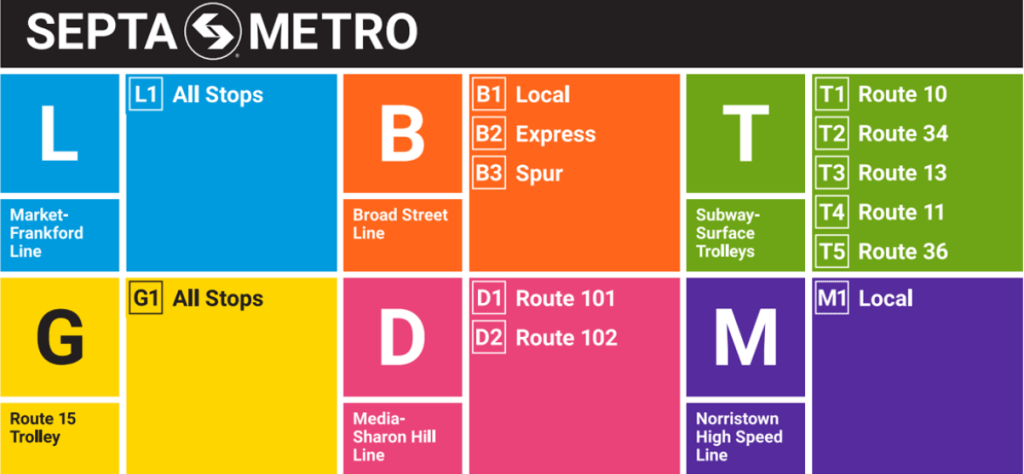
Rather than make a change that would make people’s lives easier, SEPTA has announced that they are “unifying the Market-Frankford Line [L], Broad Street Line [B], Norristown High Speed Line [M], and the routes 10, 11, 13, 15, 34, 36, and 101 and 102 into a single, easy-to-use network with new maps, signage, and communication: SEPTA Metro.”
The Broad Street Line will now be labeled as the “B” and the Market-Frankford Line, which is already locally known as the “L” will have now officially take that name. While this change is easy for Philadelphia residents to understand, tourists will likely be confused about why the “L” isn’t called the “M.”
Josh Shapiro and PA State Republicans still have yet to reach an agreement on current funding for the FY26 budget. SEPTA is supposedly operating with a $213 million deficit, according to the Inquirer. In the fight to secure funding, if an agreement is made, and another possible fare hike is avoided, it would be great if SEPTA could make this an addition to the budget.
Max Goldberg of South Philadelphia, a DIY enthusiast created his own bus clock in his home, for himself, but also to save his community from frustration, and also instill the idea that someone else could replicate this idea. SEPTA has the technology and resources to make this happen.
The countdown clocks not only help for planning, but keep you aware of emergencies and delays with local transit. New countdown clocks at each stop on the Broad Street and Market Frankford local lines would be sleek, help planning for daily travel, and have Philadelphia up to date. We don’t need “SEPTA Metro.” We need to know when SEPTA Metro is coming.
It took New York City Transit (MTA) almost 11 years to get countdown clocks at all of its nearly 500 train stops. Septa can find a way to get these clocks at the 28 train stations that the Market Frankford Line (MFL) serves, and the 25 train stops that the Broad Street Line (BSL) serves.
 Philly Plain Dealer
Leave a comment